
FlowMock fixed a demo in 10 minutes, then sat unused with zero teams
A developer spent three months polishing an API mocking tool built around session-isolated mocks, then shelved it. Now the founder is trying again.
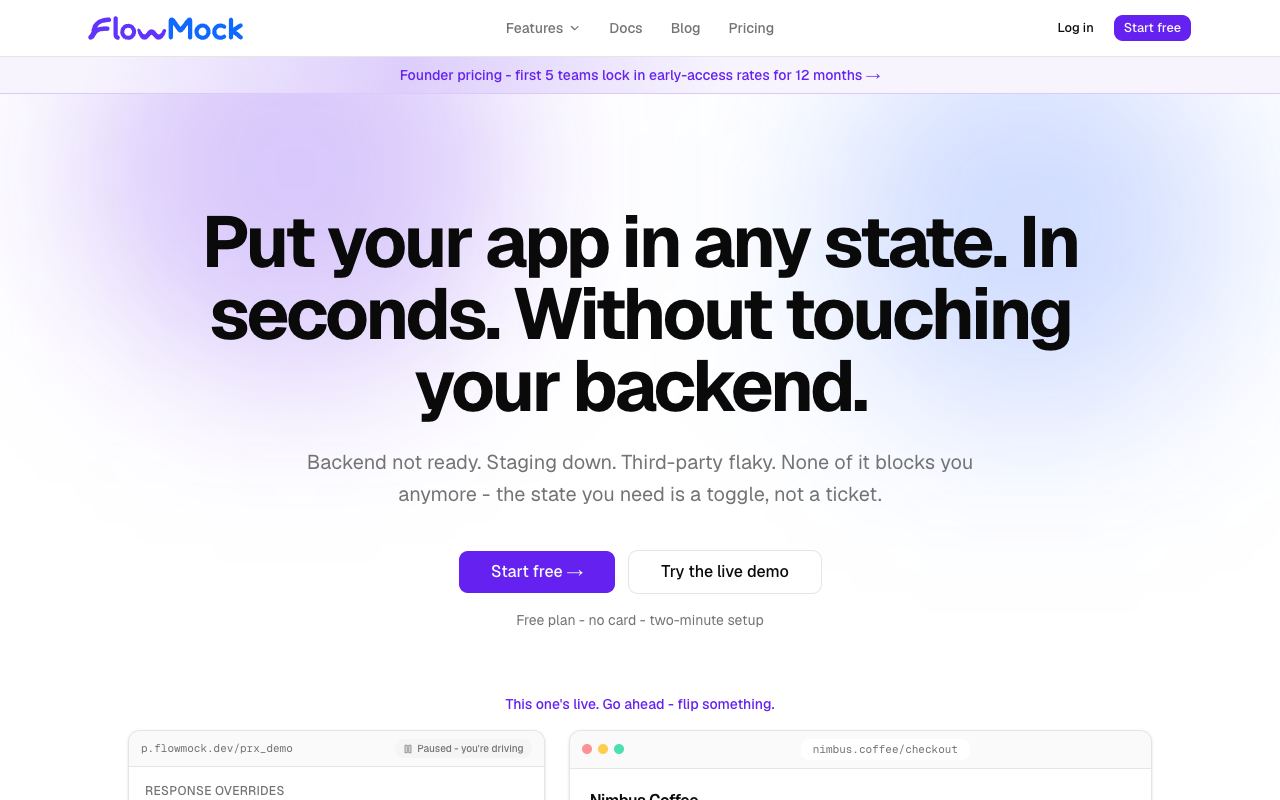
The demo was an hour away when the founder of FlowMock found out that a part of the backend the PM needed to show did not work. The backend developer was not online. Mocking the broken endpoint in FlowMock took "Like 10 mins", and then the founder turned on a feature that applies the mock to all traffic instead of a single user's session. The demo went well.
The founder later wrote that story up on Reddit, where it got 25k views. FlowMock was mentioned in the post. According to the founder, nobody clicked through to look at it.
As of the interview, FlowMock has 0 teams using it. "ashamed to admit, I launched it, used it for myself, and then ignored it because I moved on to building other stuff."
The JSON files nobody updated
Before FlowMock, the founder's team kept JSON files for every API endpoint, filled with test response data and edited by hand whenever something needed testing. The founder called it "very painful" and said the files drifted out of date because it was easy to forget to update them.
The failure that made the point: "pm wanted to show a demo and turned on mock data mode and it was throwing errors becase we didn't update the mocks to the new api sheps".
The dev team owned those files. QA did not have the technical know-how to edit them, which the founder named as part of the reason for building FlowMock. The tool offers two ways to edit a mocked response: a JSON editor, and a UI form generated from the JSON response for people who would rather not touch code.
Built around the traffic log
The founder spent about 3 months on FlowMock before showing it to anyone. That covered infrastructure on Cloudflare Workers, optimized for high throughput so it does not add latency to staging traffic passing through it, plus UI, product decisions and protection against malicious use. The founder said that delay contradicts a personal belief in launching as early as possible.
Part of that time went into UX. The founder tried 2-3 competing tools and found them hard to follow: "IT was just : here are the forms, figure out how it works." The founder attributes this to developers building for developers, and admits to the same habit of thinking in CRUD.
The screens that took the most rework were the traffic log and mock authoring. The first version opened a form to write mock JSON. The founder decided that was disconnected from how people work: they look at live traffic and want to change one property. FlowMock now lets users edit a response in place. The edit is saved in the background as a mock, switched on, and served on the next request.
Mocks are scoped to one person's session by default. "because if we apply a mock to everyone, multiple QAs testing can step over each other and not be able to do their job, so session isolation is a core feature of flowmock"
Pricing by sessions, not seats
FlowMock charges teams by concurrent active sessions rather than per seat. "If you charge by seat, maangers are scared to invite team members because it will increase the bill." The goal, in the founder's words, is to get as many people in a company using it as possible.
The pricing page lists a free plan for one person, Dev at $25/mo for up to 3 people, Team at $99/mo and Business at $249/mo. A Founding Team offer at $49/month for the first 12 months is limited to the first 5 teams. None are taken.
Zero teams and an open question
The launch was Reddit posts in QA subreddits and the sideproject subreddit, plus helpful comments on other people's posts. The founder reported 0 engagement and interest.
The founder is now returning to FlowMock to focus on marketing, with a worry: AI tools now do much of the work. Asked where FlowMock still saves time, the answer was direct: "nowhere, I didn't have a need to use it in months, that's why I'm afraid." The founder suspects some teams could still benefit, does not yet know how to find them, and is considering a pivot toward AI-powered coding and QA workflows without a defined plan.
The first paying customer the founder pictures is a medium-sized product team with at least 3 QAs. One QA can mock their own responses, two is manageable, but at three, in the founder's view, knowledge gets scattered and a shared library of mocks starts to make sense.
FlowMock is for QA and dev teams testing against shared staging APIs, and is at https://flowmock.dev/.
This story was written from a written interview with the founder, conducted by an AI interviewer and reviewed by the founder before publication.